UFC 331 model picks: Tuivasa at +452 and the age argument
UFC 331 predictions: our model gives Tai Tuivasa 53 percent against Robelis Despaigne while the market prices him at +452. The three fights where we disagree.
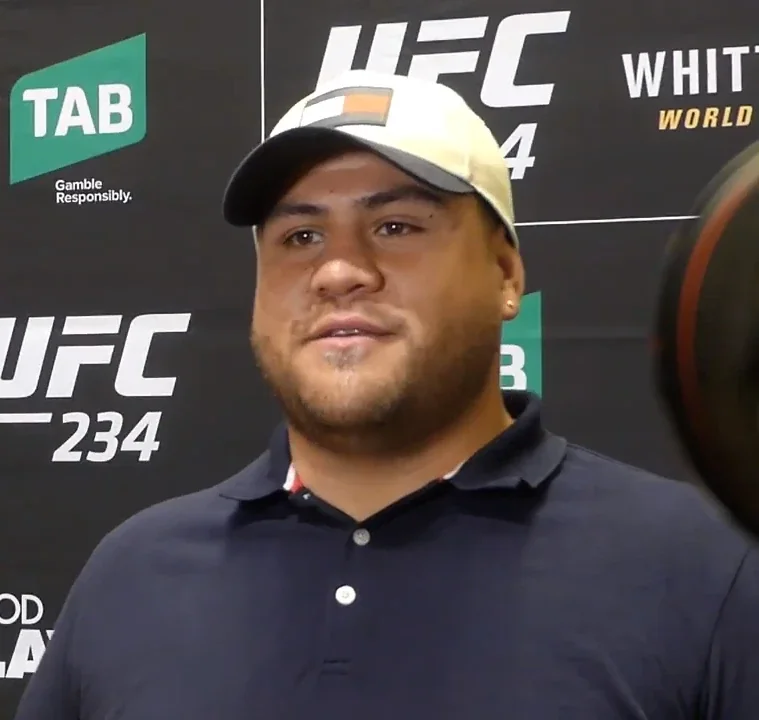
Twelve fights land at Crypto.com Arena in Los Angeles on Saturday night, and our model disagrees with the betting market on three of them. That is not unusual. What is unusual is that it disagrees for the same reason every time.
I went through all twelve bouts on UFC 331, put our model's win probability next to the consensus price from the 24 books we track, and the pattern fell out on its own. Every fight where the model and the market are more than ten points apart is a fight where one corner is over 32 and the other one isn't. The model is buying youth. The market is buying results. Somebody is wrong, and I do not think it is as obvious which one as the prices suggest.
The Tuivasa number
Start with the one that made me check the query twice.
Tai Tuivasa is a +452 underdog against Robelis Despaigne on the prelims. That is an implied 18 percent before the book takes its cut. Our model gives Tuivasa 53.4 percent. A 35-point gap is the widest disagreement on any card we have priced this month, and it is not close.


So who is right? The honest answer is that the model is making one argument very loudly and ignoring four others.
Look at what the drivers actually say. Age is the single biggest factor in the calculation, worth plus 0.37 to Tuivasa, and it is there because Tuivasa is 33.5 and Despaigne is 38.1. The model classifies Tuivasa as half a year past his physical peak and Despaigne as five years past it. That one input is doing almost all of the work.
Everything else on the sheet points the other way. Size goes to Despaigne at minus 0.242 (84 inches of reach against 75, and five inches of height). Striking goes to Despaigne at minus 0.231, on 60 percent accuracy against 49 and a lower absorption rate. Octagon record goes to Despaigne at minus 0.165, which is a strange one until you see the underlying numbers: Tuivasa has eighteen prior fights at a 44 percent win rate, Despaigne has three at 33 percent, and neither man walks in on a win streak.
That last part is the market's whole case, and it is a good one. Tuivasa has lost five in a row: submitted by Alexander Volkov in September 2023, submitted by Marcin Tybura in March 2024, a split decision to Jairzinho Rozenstruik that August, a unanimous decision to Tallison Teixeira in January, and a unanimous decision to Louie Sutherland in May. Five fights, no wins, two of them ending on the mat.
The market's case against the model, then, is simple: you cannot be the fresher man if you have been getting beaten for three straight years.
The model's case is that Despaigne has not fought since October 2024, which is 23 months of inactivity, and that he lost both of his last two by unanimous decision, to Austen Lane and to Waldo Cortes Acosta, after starting his UFC run with a first-round knockout of Josh Parisian. A 38-year-old heavyweight who has been idle for two years and is 1-2 is not a 95th-percentile favorite in anyone's honest accounting, and +452 prices him close to one.
I will take the middle. Despaigne should win this. But the price says this is a formality, and nothing about a 38-year-old on a two-year layoff is a formality.
Prediction: Despaigne by decision, and closer than the number.
The same argument, twice more
Here is where it gets interesting. Run the other two disagreements and the driver sheet reads like a photocopy.
Michael Aswell Jr. is +185 against JooSang Yoo on the prelims, an implied 35 percent. Our model gives him 51.7. The top driver is age, worth plus 0.41, because Aswell is 26 and in his prime window while Yoo is 32.7 and flagged as three years into the fade. And again, the next driver down goes the other way: striking at minus 0.328, on 59 percent accuracy for Yoo against 43 for Aswell, and Aswell absorbing seven significant strikes a minute to Yoo's five.
Seven a minute is a lot. Aswell has lost his last two, both by unanimous decision, to Luke Riley in March and Gaston Bolanos in June. Yoo knocked out Jeka Saragih in a round in June 2025 before getting stopped himself by Daniel Santos that October.
Casey O'Neill against Eduarda Moura in the early prelims runs the same play in reverse. The market has O'Neill at -227, an implied 69 percent. Our model has her at 53.1, basically a coin flip. Top driver: age again, plus 0.265, O'Neill 29 and in prime, Moura 32.6 and fading. Second driver: grappling, minus 0.171, because Moura lands 3.6 takedowns per fifteen minutes to O'Neill's 1.4 and holds more control time.
O'Neill is coming off a first-round finish of Gabriella Fernandes in March. Moura lost a decision to Wang Cong in February. On recent form the market's number looks sane, and the model is essentially saying that a 29-year-old who finishes people should not be a two-to-one favorite over a 32-year-old with better takedown numbers.
Prediction: Yoo by decision. O'Neill by decision, but I would not put a house on it.
What the model is actually telling you
Three fights, one lever. That is worth saying plainly, because it is both the model's most interesting claim and its biggest exposure.
The claim is that the sport's pricing does not discount age hard enough, particularly past 32 and particularly in heavyweight divisions where a name stays sellable long after the reflexes go. If that is true, the market is systematically overpaying for the older man in exactly the spots where our numbers flag it, and Saturday is a three-fight test of it.
The exposure is that age is the crudest input on the sheet. It does not know that Tuivasa's last five losses include two submissions, which is a durability signal and not a birthday. It does not know how Aswell got hit seven times a minute. Our model reads a date of birth and a career curve; the market reads the tape and the last three fights. One of those is better at pattern recognition, and it is not always the one with the GPU.
The rest of the card, where everyone agrees
The other nine fights are quiet, which is its own kind of information.
The main event is the closest thing to a real fight on the card and both sides know it. Joshua Van (10-1) defends the flyweight title against Alexandre Pantoja (14-4), the man he took it from in 26 seconds at UFC 323. The market has Van at -137, an implied 58 percent. Our model likes him more than that, at 71.9, which is the fourth-largest gap on the card and the only one in the main event. Van has won ten of eleven and stopped Tatsuro Taira in the fifth at UFC 328. Pantoja held the belt for two years and has six submission wins.
In the co-main, Arman Tsarukyan is -317 over Maurício Ruffy, an implied 76 percent, and the model says 72. Four points apart is agreement.
Gable Steveson at -2310 over Sean Sharaf is the card's one genuine mismatch on paper, and even there the model fades the price a little, 83.8 against an implied 96. Patricio Pitbull at +220 against Dooho Choi, Marlon Vera at +178 against Charles Jourdain, Giga Chikadze at +317 against Joanderson Brito, Alonzo Menifield at +201, Ryan Gandra at -540 and Edmen Shahbazyan at -177 all sit within six points of what our model thinks. On nine of twelve fights, the machine and the money have nothing to argue about.
Which is the part I would hold onto when you see a number like +452 and assume somebody has made a mistake. Most of the time the market is right and the model nods along. It is the three fights a night where they split that are worth watching, and on Saturday all three of them are an argument about how old is too old.
Early prelims open at 5:30 p.m. ET, prelims at 7, main card at 9. Full card, start times and where it streams in your country are at how to watch UFC 331, picks go in at the pick'em, and live results land on the event page.