Tsarukyan went 1 for 10 on takedowns and knocked Ruffy out
Arman Tsarukyan landed one takedown from ten attempts against Mauricio Ruffy at UFC 331, then finished him at 4:56 of round one. The failed shots were the point.
Ten takedown attempts. One takedown. And then a knockout with four seconds left in the round.
Arman Tsarukyan beat Maurício Ruffy at UFC 331 in the least Tsarukyan way available, and the box score is so lopsided it looks like a typo: 1 of 10 on takedowns, 3:00 of control time, eight significant strikes landed out of nineteen thrown, one knockdown, TKO at 4:56 of round one. Ruffy landed four significant strikes all night, from ten attempts, and never attempted a takedown of his own.
We spent fight week on Ruffy's takedown defense, because it is the best number he owns: 87 percent across his UFC career. It held up, more or less. He stopped nine of ten. He lost anyway, and the nine he stopped are the reason.
The nine that missed are the offense
The received version of a wrestler-striker fight goes like this: the wrestler shoots, the striker sprawls, and each failed shot is a small win for the striker, because he burned the wrestler's gas and kept the fight where he wants it. Nine sprawls in under five minutes ought to be a highlight reel of defensive work.
It is not, and here is the mechanical reason. A takedown attempt that fails against the fence does not return both fighters to neutral. It returns them to a clinch that the shooter entered on purpose and the defender entered backwards. Tsarukyan racked up three full minutes of control time in a round that lasted 4:56, which means he spent roughly sixty percent of the round attached to a man whose entire case is what he does at range with his feet.
Ruffy's career numbers are a striker's: 3.93 significant strikes landed per minute, 56 percent accuracy, 3.66 absorbed. On Saturday he landed four. Not four per minute, four. You cannot kick a man who is holding your hips, and the ten entries were never really about getting him down.
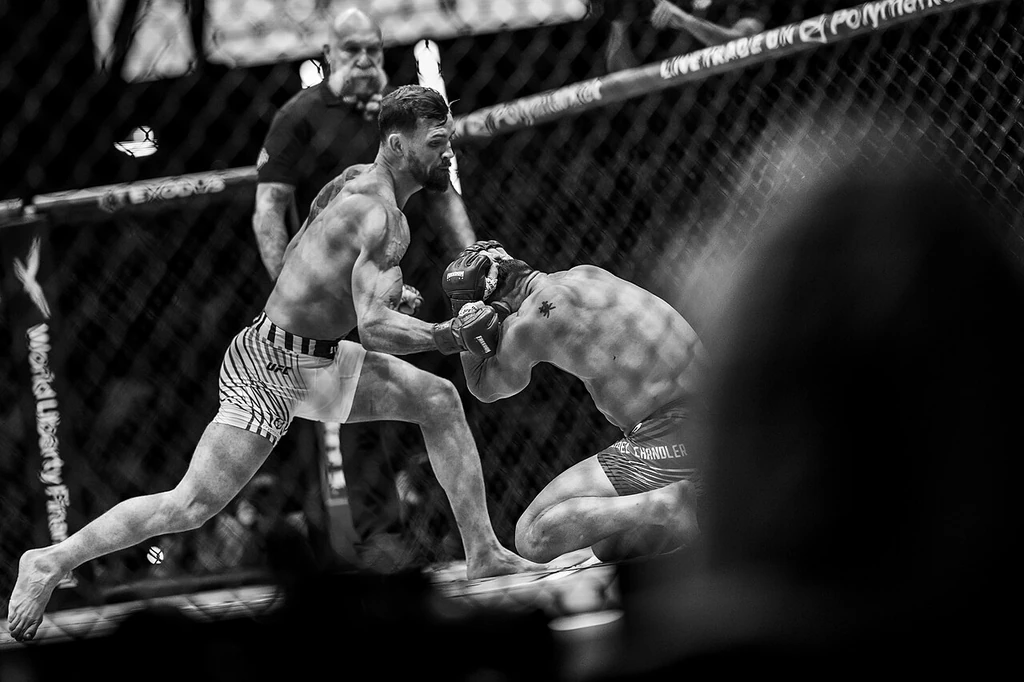
Photo: The White House / Public domain

Volume as a wrestling tool
Look at Tsarukyan's career line and the Saturday version stops looking like an aberration. He averages 3.25 takedowns per fifteen minutes at 34 percent accuracy. Thirty-four percent. That is not a man who lands takedowns, that is a man who attempts a great many of them and accepts that two in three will fail, because the failures are doing work of their own.
Against an 87 percent takedown defender the math comes out the same as against a 50 percent one: shoot enough and you are living in the clinch either way, and the clinch is where a striker's accuracy goes to die. Ruffy's 56 percent career accuracy came out at 40 percent for the night, on a total of ten attempts, in a round where he should have been throwing thirty.
The knockdown arrived at 4:56, which is the other detail worth keeping. Tsarukyan did not need the round; he was going to win it on the cards comfortably. He finished it in the last four seconds of a round he had already banked, against an opponent who had spent five minutes being moved around by his hips rather than his hands.
The thing a sprawl cannot buy back
There is a version of this fight that Ruffy wins, and it is not the version where he defends better.
His own takedown line reads 0.00 landed per fifteen minutes across his UFC career, which is not a criticism, it is a description: he is a pure striker who has never needed the wrestling exchange and so has never built a way to profit from one. When a level change comes at him, his options are to sprawl and reset, or to frame and reset. Both end with him backing up. Neither ends with Tsarukyan paying.
Compare that with what the good counter-wrestlers in the division do with the same entry. They meet the shot with a knee, or they let the clinch happen and punish the head position, or they take the back off the failed lift. Each of those turns a sprawl into offense. Ruffy's nine successful defensive sequences produced, by our count, nothing on the score sheet at all.
And this is where the round vanished. Five minutes is not very long, and once you have spent three of them attached to a man, the fight has already been scored whatever happens in the last ninety seconds. What happened in the last four is that Tsarukyan put him down.
What it means at 155
Tsarukyan came in ranked second at lightweight and fourteenth pound for pound on our September 15 board, at 24-3, and the market had him around -300, which is the price for a solid favorite rather than a mismatch. Ruffy at 14-3 was the live dog a lot of people took, and the case for him was real: he has faster hands, better distance striking, and a defensive record against exactly the thing Tsarukyan does.
What he did not have was an answer to the attempt rate. That is the part of this fight I would keep if I were the rest of the division: you do not beat Tsarukyan by stopping his takedowns, because stopping his takedowns is a service he is happy to be sold. You beat him by making the entries cost something, and Ruffy never made one cost anything.
Whether anyone at 155 actually can is a different article, and it will probably need Ilia Topuria in it.
Round-by-round stats and the full card are on the UFC 331 event page; the lightweight board is at our rankings.