UFC & MMA Blog · Investigations
Allen vs Duncan: the market says Allen, our model says Duncan
Allen vs Duncan odds against our AI model: sportsbooks make Brendan Allen a -132 favorite, the model gives Christian Leroy Duncan 63 percent. Here is why.
On November 18, 2023, Brendan Allen choked out Paul Craig in the third round of a UFC Fight Night main event in Las Vegas. Eight bouts earlier on that same card, Christian Leroy Duncan stopped Denis Tiuliulin in the second round. Nearly three years later they meet each other at the top of the bill, five rounds at middleweight, Saturday at the Meta Apex.
The sportsbooks have a clear opinion about it. As of Wednesday afternoon the consensus sportsbook line makes Allen a -132 favorite with Duncan at +108. Take the bookmaker margin out and that is roughly a 54 percent chance for Allen.
Our model disagrees, and not by a little. It gives Allen 37.1 percent and Duncan 62.9 percent. That is a 17-point gap on a main event, the widest disagreement between the model and the market anywhere on Saturday's main card.
I want to be upfront about what this piece is and is not. It is not a pick, and it is not betting advice. A model and a market looking at the same two men and landing on opposite sides is simply the most interesting number on this card, and the only honest way to treat it is to open the model up and check its reasoning line by line.
The receipts the model is reading
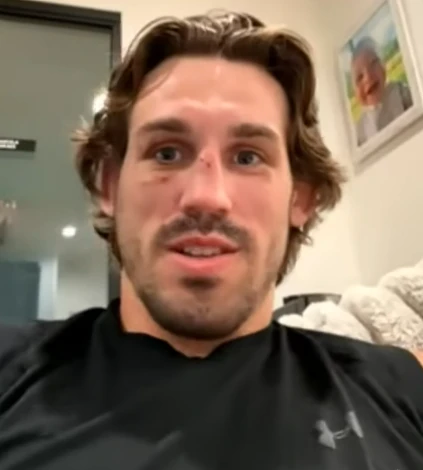 Photo: WEIGHING IN / CC BY 4.0
The model shows its work as a short list of factor groups, each pushing toward one corner. On this fight every single group points the same way, toward Duncan. In order of weight:
Striking. This is the biggest push by a distance. Allen absorbs 3.8 significant strikes per minute across his UFC run; Duncan absorbs 2.4. Allen's striking defense sits at 48 percent, Duncan's at 54. Allen lands 52 percent of what he throws, Duncan 58. Duncan also out-lands him on volume, 4.45 significant strikes per minute to Allen's 3.74. There is not one striking line in this matchup where Allen has the better number.
Pre-UFC pedigree. Duncan never lost before the UFC, with an 86 percent finish rate on the way in. Allen arrived with three losses on his record and a 36 percent finish rate. The model counts that as the second-largest factor, which is generous to a résumé built before either man had a UFC contract.
UFC record. This one surprised me. Allen has twice the UFC experience (20 bouts to 10, counting his Contender Series win) and twice the wins (16 to 8). The one line in this group Duncan owns outright is the streak: five straight to Allen's three. The model still scores the group in Duncan's favor, and the page does not tell me how much of that is the streak and how much is Allen's mileage.
Opposition level. Our own UFCalendar Power Index has them six points apart, 1,918 to 1,912. As a supporting note it says only this: on our rating's reading of both careers, this is as close to an even fight as that number gets.
Size. Both men stand 6'2". Duncan has the reach, 79 inches to 75.
What the fight film says about the striking gap
The striking factor is not a statistical ghost. You can see it in Allen's recent wins, which have been closer on the feet than the results suggest.
In June, Allen beat Edmen Shahbazyan by unanimous decision. He landed 89 significant strikes. Shahbazyan landed 90. Allen had 28 seconds of control time and one takedown from four attempts. At UFC 318 against Marvin Vettori, the count was 111 to 109 in his favor. Those are wins, and they count, but they are wins where Allen got hit almost exactly as often as he hit back.
Now look at Duncan's last two. Jared Cannonier took him down five times in eight attempts in July and held 6:12 of control. Duncan still won a unanimous decision, because standing up he out-landed Cannonier 68 to 15. In March, Roman Dolidze landed three of four takedowns and held 7:07 of control. Duncan won that one too, 54 significant strikes to 10.
That is the case for the model in two fights. Wrestlers have put Duncan on his back and still lost the minutes they spent standing by margins of four or five to one.
What the model cannot see
Here is the case for the market, and it starts with a number that does not appear anywhere in the model's list.
Allen has headlined four UFC cards. He is 4-0 in them. He submitted Andre Muniz in the third round, submitted Craig in the third, went the full 25 minutes to take a split decision over Chris Curtis in their rematch, and beat Reinier de Ridder in Vancouver when the fight was stopped after the fourth round. In that de Ridder fight he held 11:39 of control time.
Duncan has never fought past 15 minutes in the UFC. All ten of his UFC bouts were scheduled for three rounds, and he has never headlined. Saturday is his first main event and his first scheduled five-rounder.
That matters for exactly the kind of fight the striking numbers describe. If Duncan wins the standing exchanges and Allen wins the grappling exchanges, then the longer the fight goes, the more minutes there are for Allen's control game to bank. Allen averages 1.48 takedowns per 15 minutes at 42 percent accuracy, and one submission attempt per 15. Duncan's takedown defense sits at 58 percent. Against de Ridder, a decorated grappler in his own right, Allen won the ground.
There is also a rankings gap the model does not weigh directly. In the UFC's latest middleweight rankings, Allen is No. 4 and Duncan is No. 10.
Where the price has been
The sportsbook line opened on October 1 at -141 for Allen and +121 for Duncan. It climbed to -157 on Allen by the evening of October 3. Since then it has drifted back. On Wednesday morning, Eastern time, it sat at -142, and by early afternoon it had slid to -131 before settling at -132.
So the market started roughly where it is now, firmed on Allen for a weekend, and has spent the week walking back toward Duncan. Nobody outside the books knows who pushed it, and I am not going to pretend to. What the line does show is that the market's confidence in Allen peaked early and has been leaking since.
Our model's number was last refreshed late Tuesday night and sits firmly on Duncan.
Both of these things can be true at once. Duncan can be the better striker on every measurable line, and Allen can still be the man better built for 25 minutes. The model is betting on the first fact, the market on the second, and for once the two of them are not quietly agreeing with each other.
The full card, start times and broadcast details are on the event page. Prelims start at 5 pm ET and the main card at 8 pm ET Saturday. If you think you know which one is right, the pick'em is open. Somebody is going to be wrong in public by Sunday morning, and this time it might be us.